Free tool: Van Size Calculator
Not sure which van fits your move? Answer a few questions and get an instant recommendation. Try our van size calculator.
Choosing the right van size is crucial. Too small and you'll need multiple trips. Too big and you're paying for space you don't need. Here's how to get it right.
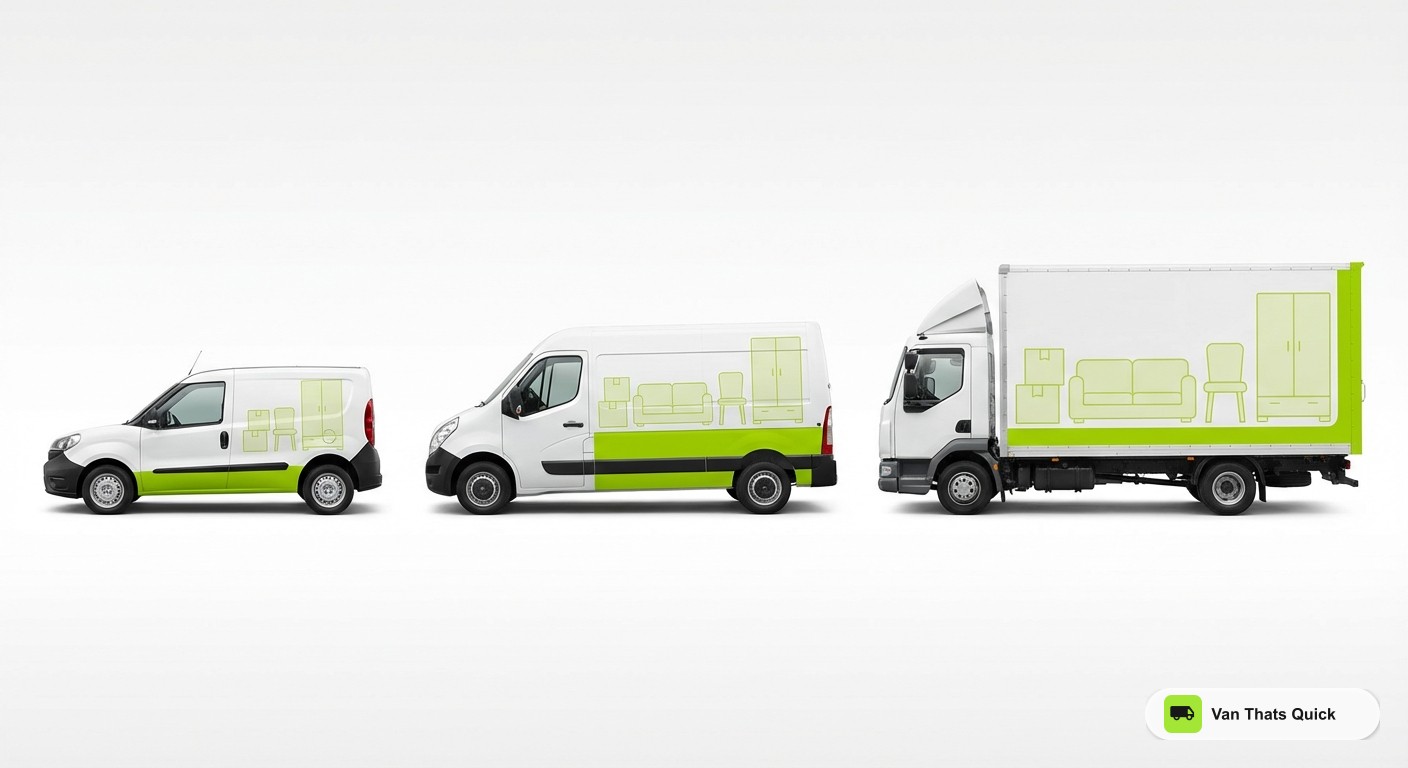
Van Sizes Explained
Small Van (SWB)
Load space: ~6 cubic metres
Good for: Single items, small student moves, 10-20 boxes
Medium Van (MWB)
Load space: ~10 cubic metres
Good for: Studio or small 1-bed flat, 20-35 boxes plus small furniture
Large Van (LWB) - Most Popular
Load space: ~10-12 cubic metres
Good for: 1-2 bed flat, 35-50 boxes plus furniture, most London moves
Extra Large / Luton Van
Load space: ~18-20 cubic metres
Good for: 2-3 bed house, 50-80 boxes, full household contents
Not moving but clearing out? The same Luton van is what we use for man and van rubbish removal and house clearance — you only pay for the space your waste fills, and we do all the loading.
Quick Guide by Property Type
| Property | Recommended Van | Trips |
|---|---|---|
| Single room | Small/Medium | 1 |
| Studio flat | Medium | 1 |
| 1-bed flat | Large | 1 |
| 2-bed flat | Large/Luton | 1-2 |
| 3-bed house | Luton | 2-3 |
Items That Take Up Surprising Space
- Sofas - A 3-seater can take up 1/4 of a large van
- Mattresses - King size needs careful positioning
- Wardrobes - Often the bulkiest item in a move
- Exercise equipment - Treadmills and bikes are awkward shapes
- Plants - Need to stay upright, can't be stacked
Our Recommendation
When in doubt, go one size up. The cost difference is usually £20-30, but making two trips costs far more in time and money. Plus, your items won't be crammed in tight.
Not sure? Send us a few photos of what you're moving and we'll recommend the right van size. No obligation, just honest advice.
Need a Man and Van?
Get a free quote in minutes. Same-day service available.
The four sizes, and what each one really holds
Van naming is inconsistent between hire firms, which is why people book the wrong one. The useful way to think about it is load length and load volume rather than the model name. A small van takes a sofa or a washing machine and not much else. A short-wheelbase Transit-class van takes a studio flat's worth. A long-wheelbase takes a one-bed comfortably. A Luton with a tail lift is the first size that will genuinely take a two-bed home in one trip.
The mistake that costs money is booking one size down and planning two trips. Two trips is not twice the driving — it is twice the loading and unloading as well, which is where the hours actually go. On an hourly rate the bigger van almost always comes out cheaper than the second run, and it is the single most common false economy in this whole category.
- Small van — One large item, or a car-boot-load that will not fit in a car. Studio-flat top-ups.
- SWB Transit-class — A studio or a very light one-bed. Roughly 6-8 cubic metres of usable space.
- LWB Transit-class — A comfortable one-bed flat. The most common size for a London flat move.
- Luton with tail lift — A two-bed home in one load, and the only realistic choice for heavy white goods without a lift.
How to estimate your load without measuring anything
You do not need cubic metres. Count the things that are bulky and awkward rather than the things that are numerous: sofas, beds, wardrobes, white goods, and the number of large boxes. A crew can tell the van size from that list almost immediately, because the awkward items dictate the floor space and the boxes fill the gaps around them.
The reliable shortcut is photographs. One picture per room, taken from the doorway, tells us more than any description — including the things people forget to mention, like the second wardrobe, the exercise bike, and the loft that still needs emptying. It takes two minutes and it is the difference between the right van arriving and the wrong one.
- Count the bulky items first — Sofas, beds, wardrobes, fridge, washing machine. These set the size.
- Then estimate boxes — Under 15 is light. 15-30 is a normal one-bed. Over 40 and you are into Luton territory.
- Do not forget the invisible rooms — Loft, garage, shed, and under the stairs. These are where undersized-van bookings come from.
- Send photos — One per room from the doorway. Far more accurate than any verbal description.
- Round up, not down — The cost of one size larger is small. The cost of a second trip is not.
Hiring a van yourself versus booking a man and van
Self-drive hire looks cheaper on the headline rate and often is not, once you add the things that are bundled into a man-and-van price: fuel, the insurance excess reduction most hirers take, the mileage charge on some contracts, and the deposit held against damage. Add the fact that you are doing the lifting, and that you have to return the van, and the gap narrows considerably for anything above a small load.
Where self-drive genuinely wins is a small, simple, ground-floor load with two able people and no time pressure. Where it loses badly is stairs, heavy white goods, and any job where an injury or a scraped van turns a saving into a loss. Our own rate is £89/hr with two movers on every job, with a £95 minimum — worth comparing against a day's hire plus fuel plus your Saturday.
- Check the excess — Standard hire insurance often carries a £1,000+ excess unless you pay to reduce it.
- Check the mileage terms — Some contracts include limited mileage and charge per mile after.
- Factor in fuel and return time — The van has to go back, usually with a full tank.
- Count the lifting honestly — Two flights of stairs with a washing machine is not a two-friends job.
- Compare like for like — Day hire plus fuel plus excess against an hourly crew who bring the straps and do the carrying.